

SAP Spend Connect 2024 - behind the news of SAP's ambitious, category-busting approach to spend and beyond
 October 17, 2024
- Summary:
- I can still remember a time when I considered SAP's "Business Network" mantra two thirds hot air. But over the years, the plot thickened. Here's my opinionated news take, with a focus on Promote, and the Spend Control Tower.
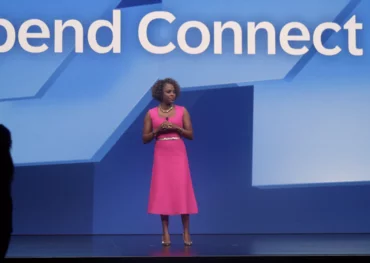
SAP Spend Connect Live is the event where we get to find out what lies behind the SAP Business Network catch phrase.
Though the "SAP Business Network" hype was once a running joke, it's a different situation now, with a different set of questions.
Start with this. During my SAP Spend Connect event review podcast with analyst Josh Greenbaum, he noted the overall growth:
We discovered how much it's been growing in recent years. They mentioned that $6.2 trillion worth of commerce flowed through the Business Network in the last year. When I look back at my notes, in 2018, Ariba Network had one $1.8 trillion flowing through it. That's a pretty dang significant growth rate.
On the day one keynote, Manoj Swaminathan, President, Intelligent Spend and Business Network at SAP, said that SAP Spend Management has the highest level of product investment inside of SAP, aside from SAP ERP. (S/4HANA).
But with that level of investment comes new pressures. And: can that $6.2 trillion translate to revenue growth that would make quarterly noise on Wall Street? More importantly: can SAP deliver what customers need, for industries that are challenged by supply chain instability on the one hand, and the need to justify value beyond filing expense reports on the other?
Spend Connect - burning questions and news stories
To address these issues, SAP has released a flurry of news stories - I'll get to a couple of them in this piece. But first - as I told Greenbaum in our podcast, I came to this show with burning questions of my own:
- Can SAP Spend Management be greater than the sum of its parts? (Those parts include a series of acquisitions, from Ariba to Concur to Fieldglass, supporting the range of indirect and direct procurement, and collaboration across logistics, supply chain, procurements, assets and finance).
- Can SAP reduce network friction and increase visibility of smaller suppliers, while improving the discovery of these suppliers by buying centers?
- Can SAP further prove the value of Business Networks via S/4HANA integration benefits?
- Can SAP Business Networks be a way into innovating with SAP for companies not ready to move to RISE or GROW? Can this be an entry point into engaging with SAP on cloud/modernization, without a major ERP upgrade? (It's important to note that SAP Business Network access is also possible through these programs; it's an add-on to GROW, with Concur included in GROW, and a network subscription is also included in RISE Premium, and RISE Premium Plus).
Behind the news - can SAP Promote change supplier visibility?
And yeah, there is the SAP Business AI angle also. Let's cover off these questions, in the context of two keynote highlights: SAP Promote and SAP Spend Control Tower. SAP Promote caught my eye, for two reasons: 1. there was an obvious buzz about this particular announcement on the show floor, and: 2. it's about giving more network visibility to suppliers. As SAP put it:
SAP Business Network in the first quarter 2025 will launch a new Promote subscription with value-added features to help suppliers differentiate themselves, attract new buyers and grow their businesses.
On the surface, Promote definitely fills a need. As I said to Greenbaum:
This speaks to something you and I both care a lot about, which is: how can smaller suppliers punch above their weight in these networks, and not get deluged by the friction of being involved, and also by the lack of visibility. Promote sounds like it is specifically designed to give these suppliers a much greater ability to show up in searches, and be visible.
But how will this work in practice? Greenbaum, who has been knee deep in SAP Spend Management research for some years now, explains:
You want to be able to put your best foot forward as a supplier, and make sure that folks know that you are compliant with the right regulations... ISO 9000 etc.; no one wants to do business with a supplier that's having human rights violations.
So you want to have those basics, but you also want to be able to really fine tune how you look to the network, whether you're performing... Promote will let you know if whether you're doing that or not, and where you're not doing it. That's a really huge thing for suppliers, because fundamentally, the Business Network only succeeds if it has a critical amount of suppliers - end of story.
Etosha Thurman, CMO, Intelligent Spend and Business Network at SAP, put it this way:
This is something we've been working on for a long time. Manoj said it well: we're starting to shift our conversation on the network, from how we deliver value to the buyers, to it being trading partners, and where do we extend value to all trading partners, no matter what persona. {romote is our first step into this, not our last. And we chose value that we've heard over and over supplier personas: 'I'm here. How do you help me stand out?'
So having analytics to say, 'Hey, your category had this much activity,' and then I can say, 'Well, I only got one RFP, so I have something to do [to stand out in that category],' and just having a type of insight. And then we also try to make it really affordable.
Greenbaum and I hit the show floor to crash the Promote booth, and get a demo. On one level, you could see this as the same kind of benefit as a LinkedIn Premium subscription, in terms of increased visibility in search - along with verification options, sustainability ratings via EcoVadis and so on. In Promote, suppliers can see how they fared in searches, update their keywords, see their geographical reach, etc:
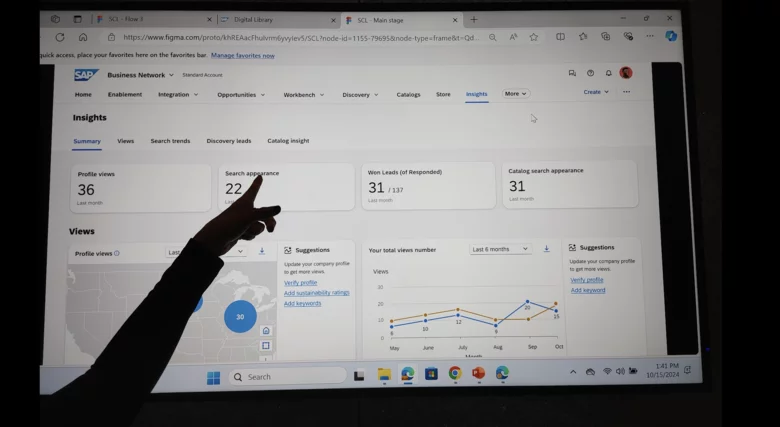
Buyers can then screen on such profiles. There is already some degree of AI built into Promote, pointing suppliers to areas in their profile that are incomplete (see: "suggestions" above), showing stats on profile views, etc. When Promote subscriptions are available in Q1 of 2025, there will also be more ease in requesting and/or filling RFPs via gen AI enabled capabilities on this enhanced profile. Suppliers can also track the most popular search terms, and how their profile fared:
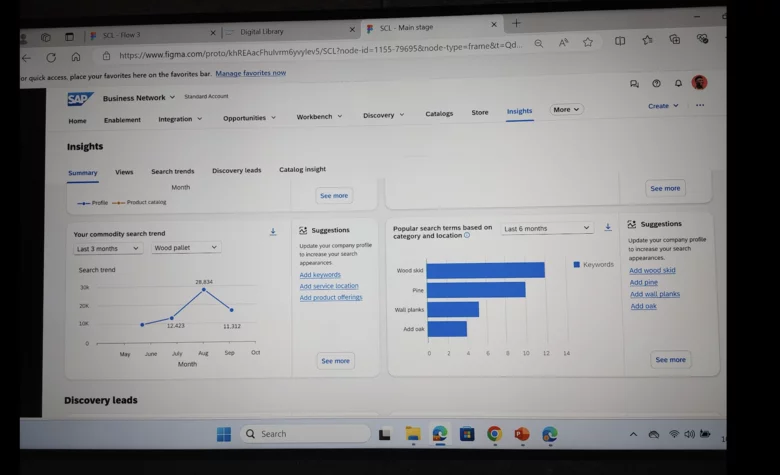
Buyers can filter on criteria such as "Active" suppliers within the network. This is why Greenbaum (jokingly) compared it to a dating app for suppliers on our podcast. During my sit down with Tony Harris, SVP & Head of Marketing & Solutions, SAP Business Network, he explained how Promote's upcoming gen AI features could help smaller suppliers:
We have a lot of small companies on the network; they don't have three people sitting in an office all day long, just being able to respond to buyer posts... It would be great if AI could start to write that response for them, and then they've just got to top and tail it - that that's a heavy lift taken off their off their shoulders.
Readers know I'm critical of many gen AI use cases, but I like this one: filling out supplier paperwork/RFPs is a heck of a task, filled with mind-numbing redundancies. Harris acknowledged gen AI isn't at the point to complete all of that bid paperwork on its own, but that's fine too. There is still value there - value of a more realistic kind than the gen AI agentic hyperbole I've heard too often this fall.
You can see how the AI aspects of Promote could evolve into making "intelligent" matches. Just how intelligent those matches will be, time will tell, but there is a clear benefit in SAP's plans for more granular profile controls, such as being able to enter in the specific ISO regulations you are compliant with - thereby allowing buyers to screen on those regulatory specifics, or perhaps ask Joule to surface suppliers with those characteristics. While on site, I asked a couple of buyers about this; they both said they would value additional supplier discovery capabilities, especially via more granular searches, such as specific ISO certifications.
My take
I wanted to spend more editorial time on the SAP Spend Control Tower news and demo as well; I found this to be a big keynote highlight, with customer Warner Music on stage speaking to its value:
The Spend Control Tower just gives me that ability to automatically derive insights and then move forward... This is a great enabler for me to look at things like our top suppliers, break down our categories, or even derive subcategories that I don't really know exist right now. It's a complicated model. It kind of gives me answers to questions that I didn't know were questions in the first place, really. And then with the dashboards and everything that comes with it, I'm creating more than just a spreadsheet. If I wanted a spreadsheet, I'd stick with that. I don't want that. I want something better, shinier.
One of the best things we heard from Warner? Activating the SAP data sources into the Spend Control Tower was easy. Warner darn near said "seamless integration," a phrase I've never heard come out of a customer's mouth - but he came pretty darn close:
We're not making up the zero integration. It was too easy to go from nothing to everything and go, 'Oh, wow, that's kind of cool.'
During that same keynote, Goldman Sachs also spoke to the Spend Control Tower, and the impact of pulling in non-SAP data sources (upcoming 2025 releases of the Spend Control Tower will enable non-SAP data integration via APIs). The current release pulls from Ariba, Fieldglass, Concur and S/4HANA.
When it comes to placing AI in a practical business context, and not overdoing it on the generative AI overdose, I thought this was the most effective show of the fall so far. I do have some nits to pick - in particular, I find SAP's doubling down on "suite first" language to be off the mark. One thing some may not know about the SAP Spend portfolio is that it's well on its way to a BTP-enabled, microservices-based replatforming (Harris said early adopters are moving now, and the goal is that most should be migrated to this new architecture by the mid point of next year). With the diverse landscapes of so many of these customers, an open applications platform message, to me, would resonate better.
Anyhow, we'll see if SAP can make "suites" sound appealing again - good luck. Don't get me wrong - a coherent look and feel (and underlying data platform) makes all kinds of sense, but how well this public positioning works remains to be seen (though SAP's leadership did make a point of also noting "composable" suites, and working with third party data and products).
In the closing Spend Connect keynote, SAP framed their leadership panel around these themes:
- Strategic collaboration
- Effortless compliance
- Increased productivity
- Seamless integration
- Informed decision making
Though I've banned "seamless integration" from my own writing until the day customers start using the term, I don't mind it as a vendor aspiration (you start to lose me if you use the phrase during product demos). When you take the five of these together, if SAP can deliver on them, then you have a value prop that encompasses geopolitical risk on the one hand, and shifting from cost control to margin expansion on the other.
Tech alone doesn't get modern procurement and supply chain teams where they need to go - not without people, process, and a thoughtful approach to managing change. Fortunately, I heard plenty of that kind of talk in Las Vegas this week. I'll get back to that in my next piece - an exceptional customer story via Molex.
For now, I go back to my discussions with Greenbaum. He and I agree on many things about SAP, but two things we don't agree on are the impact of Business Network and SAP Business Transformation Services, e.g. cALM, Signavio, Lean IX, etc. For the latter, I still need to see that these tools will fuse together - in time to make a difference during S/4HANA crunch time. But I'm coming around on the Business Network.
That "greater than the sum of their parts" thing is starting to kick in - and if SAP gets this right, there really isn't a global competitor that can do everything SAP would be capable of. And: we're starting to see the impact of the Business Network on the core ERP offering as well (more on this next time). The compliance and ESG part of this is not to be underestimated. SAP's investment in the compliance side of this, locally across regions, could become one of those competitive moats. As Harris said to me, what if every process had a networked component?
Still, there are plenty of strong vendors in both spend and next-gen supply chain planning, so, this won't be a cakewalk. Now, can SAP Business Networks be an opening for customers to partake in SAP innovations, even when they aren't ready for a big ERP transformation? Time will tell on that one. But when I say SAP should utilize more ways to kick start older customers on smaller transformation projects, this portfolio is definitely a strong candidate.
End note: thanks to Isaac Feldberg of ASUG, who provided some additional background context that helped to inform my interviews and this article.