

SUSECON 26 – it’s Prague Spring v2 as European enterprises demand sovereignty and freedom from hyperscalers
 April 22, 2026
- Summary:
- Until this week, few would have branded SUSE a hotbed of insurrection, and not just innovation. But we live in strange times, and the conference heard that the demand for change is coming from a surprising source: enterprise customers.
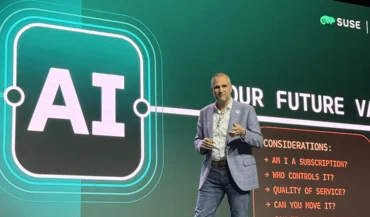
Digital sovereignty is critical, choice is under attack, and without choice, enterprises have no resilience in a world of shock and disruption. That’s the view of Frank Feldmann, Chief Strategy Officer of open source infrastructure provider SUSE.
That (appropriately) frank perspective has been the dominant theme of the entire SUSECON 26 conference in Prague this week, with every keynote, presentation, roundtable, and interview ticking at least one of those boxes.
But what does any of this mean? Though speaker after speaker has opted for diplomacy by referring broadly to “the geo-political situation”, it has all been code for one thing: Trump v2.0 and everything connected with it. The US Presidency has seen transatlantic alliances torn up, trade and energy instability spreading, and increased politicization within the tech sector itself.
Meanwhile, attacks on the enterprise have been increasing – over half (51%) of respondents to a SUSE enterprise survey report a foreign entity accessing their systems – and AI disruption is upon us too. So, who can blame organizations for wanting to put themselves back in control, and reduce their reliance on proprietary titans?
Disruption has moved at the speed of an Executive Order, and AI has been part of that, says Feldmann:
Ask yourself, ‘Am I just an annuity in this relationship?’ And if it feels that way, you probably want to do something about it. Your processes, your data, your expertise, and your context: you're feeding all of this into some form of AI service.
Now, some of you might be smart, and you're doing this locally, protected, and into an AI that you control. But the majority of us are silently teaching someone else's super AI how to build a digital twin of our companies. So, ask yourself, ‘Is my digital twin going to be a subscription that I don't own?’
It’s an astute observation, and the key question of our age is: are we training our replacements? He adds:
I see my children, and I'm super excited for them because they're growing up with Harry Potter powers in their hands: they can just imagine what they want and make it happen. But at the same time, this concentration of, let's call it ‘model monopolies’, creates a huge amount of power [in others’ hands]. I worry that I'm not going to be in charge of my own digital twin, that it will run away from me if I'm not careful.
So, what should the strategic enterprise response be? Feldmann says:
What choice do you have? Think about that, and your ability to reset it and revoke it. And then there is the geo-politics. I will not spend a lot of time on that, because you all watch the news – and if not, you're probably fuelling your car and realising that something has happened. But this is something that's impacting the IT stack too.
That these debates have become political is now impossible to ignore. Feldman notes that national sovereignty is a significant element of its digital counterpart:
Just the other day, France announced, ‘We're cancelling Microsoft’. I was like, 'Whoa!' I've been in IT for 20-plus years, but I have never, ever seen a country say, ‘We are cancelling vendor X in our country’. That's how big this topic has become.
Feldmann is referring to the French government’s long-trailed decision last week to move 2.5 million government employees off Windows and onto Linux as part of a national strategy to reduce reliance on US tech. It has been presented in some quarters as an unjust war on American IT, but really it is a reaction to US vendor overreach, backed by White House Executive Orders, a sweeping aside of state regulation, and the threat of punitive tariffs against anyone who doesn’t buy American tech.
The US proprietary tech sector needs to get real about this. When vendors stood shoulder to shoulder behind the President at the Inauguration last year, there was a lot to come policy-wise - anti-diversity policies, aggressive sanctions, threats to allies and neighboring states, the dismantling of traditional Western peacekeeping alliances, the rejection of American 'soft power', and a repudiation of climate consensus. Some may have been unaware that this would be the price of their support for a President who, at the time, perhaps merely represented a chance to deregulate AI at scale. But now, over a year later, who can be surprised that non-US customers are exploring other options? Can they really be blamed for that?
The choice
Open source is at the centre of re-asserting enterprise choice, Feldmann noted that this week SUSE held its first Sovereign Summit, a significant event :
This sovereignty thing, it's super alive in Europe. And the word ‘resilience’ popped up a lot of times in conversations, because it is really about building the capability to have choices inside your operation that you can exercise, and that you can activate in a way that is timely. Let's call it that, rather than surprises that are nasty to get out of
Choice is necessary, if not fundamental, to having resilience, he asserted:
For SUSE, choice is a fundamental value. It's not something you just stick on a t-shirt. It’s something you should experience as a customer when you buy or consume our products and services...In the Sovereign Summit, this was everywhere. It was in constant conversations about, ‘Hey, we need to be independent. We need to have a choice.’ But here's the thing, guys: if you don't have the option to shift built into your architecture, and built into your thinking upfront, then you're going to be in trouble.”
Let’s pause to consider the implications of all this. Though $6 billion SUSE is a European company – a quiet revolutionary that is often overlooked when people complain about that lack of home-grown players – it has countless American partners, including NVIDIA, Dell, and Oracle. Meanwhile, open source is a global movement that knows no borders. So, for an infrastructure software conference to be so overtly political is extraordinary; indeed, it is unprecedented in my experience.
But if SUSE is to be believed, all this is bubbling up from enterprise users, mainly (but not exclusively) outside the US. That constituency seems to be growing alarmed at the threat to day-to-day operations originating from their reliance on US Big Tech.
According to several speakers, more and more of those enterprises are asking companies like SUSE what their options are for escaping the grip of the proprietary world and reasserting their sovereignty – in data, in services, in infrastructure, and, as we have seen, also in national terms.
By overstating American hard power on the world stage, it seems the US President has begun undermining it, implicitly dragging some of the biggest names in IT along with him. And buried deep within all this talk must surely be a realization among those American behemoths, such as SUSE’s partners – AWS figured large in workshops, while NVIDIA shared the conference stage with CEO DP van Leeuwen at his keynote – that the situation may be getting out of control.
Or as Feldmann puts it:
You should be in a position to shift as fast as a politician can sign an Executive Order, and make choice happen. And we believe that SUSE, if you bet on us, and you work with us, will help you get there.
This matters, he states:
For me as Chief Strategy Officer, I care about this a lot, because it's my job to make SUSE agile. And trust me, being a European software company is amazing right now, because if you're in Europe, everyone wants to have this discussion. But it's also challenging, because we're a global software company. And we have been one for a very long time. But you can't be global that easily anymore. So, making choice happen is not a tagline, it's not a sticker, it's not a luxury. This is beyond a procurement preference now. I would refer to it as ‘exit velocity’. How fast can you get out of a bad deal?
He goes on:
You hear ‘choice’ every minute, ‘resilience’ every two minutes, and ‘sovereign’ every four minutes. But for the first time now, we see an emotional connection to this subject, a realisation that sovereignty has become personal to people. And that's a geopolitical influence, there's no doubt about it. But while sovereignty is the current theme, the underlying thing that everyone is really trying to get to is resilience: more control, with you behind the levers controlling the dials and knobs. I call it exit velocity plus pivotability. Those are the two key elements that any strategy today really needs to concentrate on.
Voices
To underline the importance of the sovereignty theme, a SUSE roundtable aired other voices in the debate, including Andreas Prins, SUSE’s Global Head of Sovereign Solutions. Referring to new SUSE research, which finds 98% of enterprises saying that digital sovereignty is a priority (with 52% taking active steps towards it), he says:
What I think is interesting is the high number of people that are taking action. That's unexpected. I mean daily conversations with executives and teams that are willing and able to move. But where I see a struggle is between the desire to move and the ability to. People at an executive level understand the need to change. But if you then ask a DevOps engineer or a platform engineer, ‘Is there stuff happening already?’, the answer is often ‘not yet’. So, we're articulating frameworks, we're articulating the desire to change with new architecture patterns, but the real move is a little bit behind. […] Plus, they are moving away from VMware to an open alternative.
(There was much talk at SUSECON of a mass exodus from VMware to open-source virtualization solutions, with SUSE’s partner Cloudbase offering it at a click of a button, via its Coriolis tool.)
But some companies have even bigger ambitions than that and see “the geo-political situation” as presenting a golden opportunity, not a threat. Matthias Astrom is CEO of Stockholm, Sweden-based evroc, which pitches it is building no less than The European Cloud. He says:
In Europe, there is only 40% cloud penetration, but in the US, it is more than 80%. If you want to be competitive with AI, you better move to the cloud. But the problem is there hasn't been a good solution, and Europe has been completely dependent on American hyperscalers. That is not acceptable. We need to change the status quo, especially in light of the geopolitical situation. The answer is software, but what you were able to get in Europe before was servers. So, evroc is building the European Cloud. We're doing it together with partners like SUSE, and the most exciting part is we're building a better cloud.
“Of course, that is a very arrogant thing to say. We're not saying we're smarter than Google, even though we have recruited a lot of their people. But we are starting 15 years later with a blank sheet of paper. So, we can really ask, ‘How do we build the cloud for AI?’ And ‘How do we build a cloud that can scale?’ This is really the exciting part. What Europe has been lacking is a cloud operating system, and we have built that now, and we're really excited to launch it together with SUSE.
While the US President has slammed “radical climate dogma” (to quote last year’s AI Action Plan), fears have been rising over AI’s colossal energy needs and carbon footprint. On that topic, evroc has a message, says Astrom, one that is all about sustainability. Around five percent of evroc’s power consumption will be from nuclear sources, but the majority will be from renewables:
When there is sunshine in Spain, maybe you train your AI models in Spain. When there's wind in the Netherlands, you move the workloads there overnight, or you move it up to the north of Europe, where there is hydropower. So, this is really a way of re-thinking things, and how you can accelerate AI deployments while keeping the sustainability.
Meanwhile Nicholas Law, Head of the Modern Infrastructure Portfolio at European cybersecurity and high-performance computing provider, Atos, argues:
There's a number of scenarios that sovereignty entails. One of them could be, ‘I'm concerned about my data leaving a particular region’. Another is, ‘I'm concerned about the services I receive up and down the stack and switching those off.’ And those are evolving concerns. There is the perceived risk from the client perspective, plus the variety of regulations and guidelines that are being introduced to control this. And those two things create ‘the sovereign dilemma’, as we describe it at Atos. This is where a client is looking to achieve the pace of innovation, and they want regular releases to be keeping pace. But they also want something that is cost effective and flexible.
In all this, open source is the answer, suggest delegates. Marc O’Regan is Chief Technology Officer EMEA at Dell Technologies – one of SUSE’s many American partners. But the affable and outspoken Irishman was far from cowed by what he heard at the event. He says:
Sovereignty is in the eye of the beholder. It is not for one brand of person, one brand of nation, or one brand of society. Sovereignty is for everyone and everything these days, and from a technology perspective, it cascades right down through the stack.
So, what is it, in O’Regan’s view? He says:
It’s understanding where your data is, where your information is, and where the patterns are that you observe or expose when you're consuming AI, and what level of risk that is to your organization, and to the individuals within it. So, sovereignty is a complex thing and it's getting more and more complex with the fracture, or with the ‘factionalization’ of the geopolitical situation, which coincides with another major event, the AI era.
While evroc's Astrom doesn't agree with the complexity point, O'Regan goes on:
There are no two ways about this: it is going to disrupt and differentiate how we do business, how we run services through societies, and what the expectations are around rules and regulations and control. So, from a sovereignty perspective, it’s about solving the problems and building the opportunities you want as a modern society. And the hardware and how it acts and interacts and communicates have to be major considerations, and they have to be tightly integrated to what we're doing in the software.
My take
An extraordinary conference. As with its long and, dare I say it, resilient history, it looks like Prague may be witnessing another Spring – this time for European software.
But ironically, it took a French journalist to prick the bubble of all this sovereignty talk. “We are all reliant on just three companies for chips,” came a plaintive voice from the back of the room. “How can you be sovereign without chips?”
As a Brit, I can only concur.